
Article: What Makes Live Edge Oak Feel Different: A Materials & Craft Guide
What Makes Live Edge Oak Feel Different: A Materials & Craft Guide
Introduction
Live edge wood has become increasingly popular in modern interior design, but many homeowners don’t fully understand why it feels different from straight‑cut timber. The difference is structural, tactile, and rooted in the biology of the tree. This article explains what a live edge is, how it forms, and why it creates a noticeably different experience in finished furniture and homeware.
1. What a Live Edge Represents
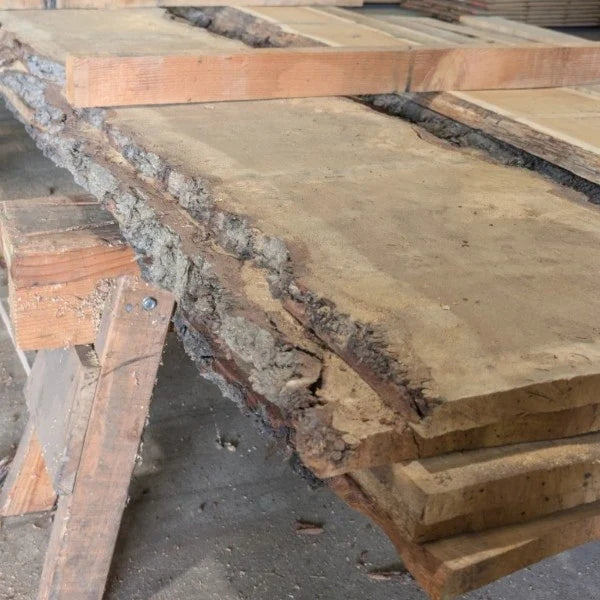
A live edge is the natural outer profile of the tree, preserved instead of being cut into a uniform straight line. Most commercial timber is milled into predictable rectangles, removing this contour. A true live edge retains:
-
the curvature of the trunk
-
the transition zone between bark and heartwood
-
irregularities formed by branches, growth stresses, and environmental conditions
This means the edge you see is the biological outline of the tree, not a manufactured shape.
2. How the Tree’s Growth Influences the Edge
The geometry of a live edge is shaped by natural factors:
-
Growth rate: Faster growth produces wider, smoother curves; slower growth creates tighter, more complex contours.
-
Environmental stress: Wind, competition for light, and soil conditions all influence the tree’s silhouette.
-
Species characteristics: Oak develops strong grain movement and distinctive character features that make its live edges visually expressive.
Every live edge is different because every tree grows under different conditions.
3. Sourcing Full‑Width Kiln‑Dried Oak
All Thriverton live‑edge pieces begin with full‑width kiln‑dried oak boards sourced from a local sawmill. Using full‑width boards is essential because it preserves the tree’s original outer profile. Narrow, pre‑cut boards lose this geometry; full‑width sections retain the true contour of the trunk.
Kiln drying ensures stability and predictable finishing. Local sourcing allows us to hand‑select each board for grain movement, character features, and structural integrity. This combination — full‑width boards, proper kiln drying, and local selection — is a major reason our live edges remain clean, stable, and true to the tree they came from.
4. Bark Removal — Why We Do It by Hand
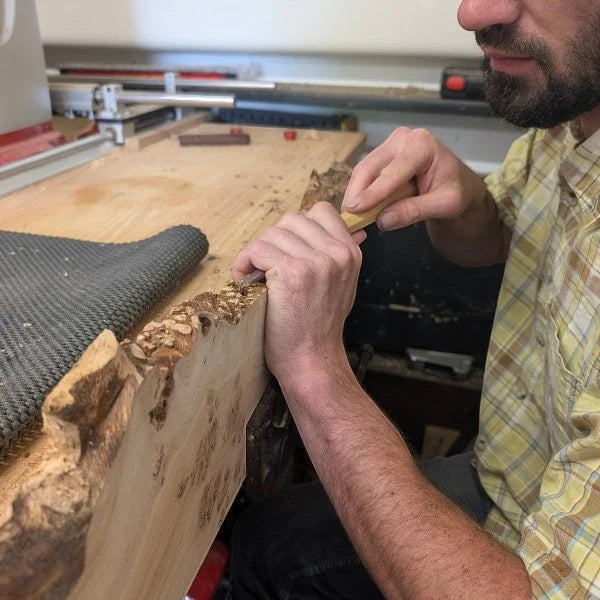
Before shaping a live edge, the bark must be removed. Bark contains loose fibres, insect channels, and moisture pockets that cannot be finished cleanly. Many manufacturers use mechanical scrapers or abrasive wheels, which are fast but often damage the underlying wood.
At Thriverton, the bark is removed entirely by hand.
Why hand‑removal matters:
-
Controlled depth: Hand tools remove bark without cutting into the cambium or outer growth rings.
-
Reduced fibre damage: Manual removal protects the denser outer fibres that contribute to edge strength.
-
Cleaner cambium preparation: The cambium is scraped and cleaned manually, creating a stable surface for sanding.
-
Preserved geometry: Machines flatten curves; hand removal follows the tree’s natural outline.
-
Superior finishing: A hand‑prepared edge sands and oils more consistently, producing a smoother tactile surface.
This is one of the reasons Thriverton live‑edge pieces feel different — the natural contour is preserved rather than machined.
5. Why Live Edge Wood Feels More Tactile
Straight‑cut edges are produced by saw blades, leaving predictable, flat surfaces. A live edge retains non‑linear geometry, which naturally guides the hand along its shape.
Because the contour varies along its length, the tactile experience is more engaging. This is a direct result of the tree’s original structure and the careful hand‑finishing process.
6. Structural Differences Between Live Edge and Straight Edge
| Feature | Live Edge | Straight Edge |
|---|---|---|
| Geometry | Irregular, natural | Linear, machined |
| Fibre density | Higher near outer growth rings | More uniform |
| Stress distribution | Variable | Even |
| Surface interaction | Tactile, varied | Predictable, smooth |
Live edges retain more of the tree’s outer fibre structure, which is denser and more impact‑resistant. This contributes to the “solid” feel many people notice.
7. Why Oak Is Ideal for Live Edge Work
Oak’s biological structure makes it particularly suitable:
-
High tannin content → excellent durability
-
Prominent medullary rays → visible grain movement
-
Character features (pippy, tiger, burr) → natural variation
-
Strong fibre density → stable edges after finishing
Oak’s natural properties ensure the live edge remains stable, attractive, and structurally sound.
8. How Live Edge Enhances Interior Design
Live edge wood introduces:
-
contrast against straight architectural lines
-
material authenticity in modern spaces
-
biophilic design elements that increase perceived warmth
-
unique geometry that prevents the piece from feeling mass‑produced
This is why live‑edge shelves, coat racks, and wall pieces often become focal points in a room.
Conclusion
Live edge wood feels different because it is different — biologically, structurally, and visually. It retains the tree’s natural contour, preserves the outer fibre structure, and introduces organic geometry into modern interiors. For homeowners who value authenticity and material character, live‑edge oak offers a combination of durability, individuality, and natural design that straight‑cut timber cannot replicate.
If you’d like to explore handcrafted Live Edge Oak pieces for your home, you can visit Thriverton here